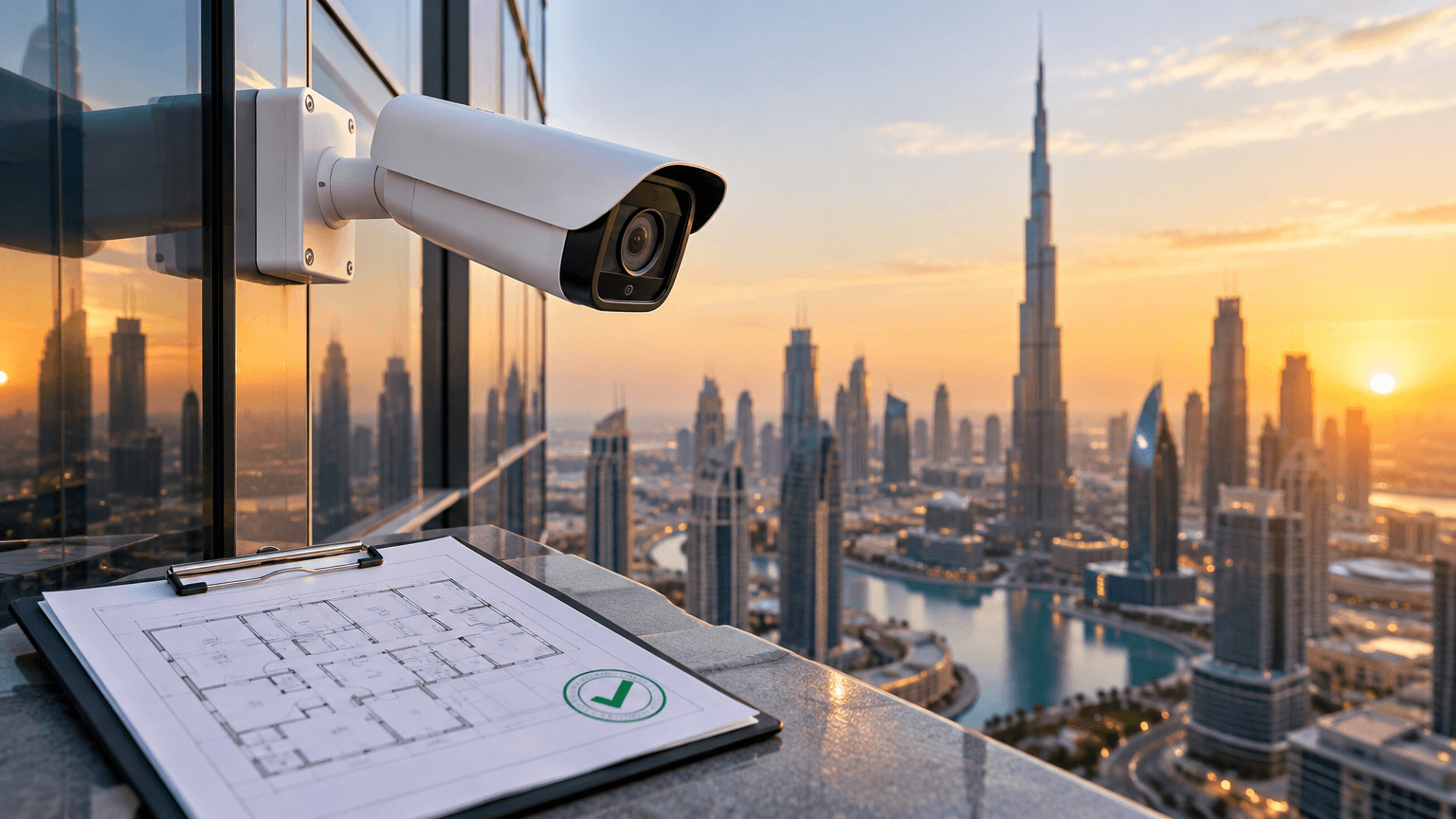
SIRA approval is Dubai's sign-off that your CCTV system meets the Security Industry Regulatory Agency's technical standard. For shops, offices, clinics and other commercial premises it's mandatory. A SIRA-licensed installer designs the system, submits it, installs it exactly as approved, and an inspection confirms it before the system is registered.
Picture the week before a shop opening. Shelves stocked. Signage up. Then someone asks, "Has the CCTV been approved?" and nobody has a clear answer.
That's the moment most people learn about SIRA. It's also the most expensive moment to learn about it, because cameras that went up without an approved design often have to come down again.
So here's how it works, from the start.
Who needs SIRA approval in Dubai?
If it's a business, yes. If it's your own villa, usually not, but privacy rules still apply.
Property
- Shop, office, clinic, restaurant, warehouse
- Holiday home or short-let
- Apartment you live in
- Villa you live in
SIRA approval needed?
- Yes
- Treat it as commercial
- Building rules apply
- Often not mandatory for exterior cameras
What to watch
- Approved design, licensed installer, registration
- Guest privacy; no cameras in bedrooms
- Indoor only; corridors need building consent
- Don't point cameras at neighbours or public areas
The holiday-home row catches people out. The moment you're running a licensed activity from a property, you've moved into the commercial bracket. If there's any chance your use will change, it's simpler to build to the SIRA standard from day one.
What SIRA actually checks
SIRA publishes a technical specification for security systems, and every licensed installer works from it. You don't need to read all of it (it's long). But you should know what the inspector cares about:
- Resolution: Cameras have to be good enough to identify a face, not just show "a person." Older 1MP analogue cameras won't pass.
- Retention: Footage has to be kept for around a month. Sources quote 30 or 31 days for typical premises, and higher-security sites need longer. Ask your installer which figure applies to your premises under the current spec.
- Approved equipment: Cameras and recorders need to come from SIRA's approved list.
- Wireless cameras: Wi-Fi or 4G cameras also need TDRA type-approval. Wired PoE cameras don't.
- Built as drawn: The inspector compares what's on the wall with the approved design. A camera that moved two metres can be a problem
That last point matters more than people expect. Approval is for a specific design, not for "some cameras at roughly these spots."
Approval is for a specific design, not for "some cameras at roughly these spots."
The approval process, step by step
- Confirm your category: Commercial, residential, or a regulated sector with stricter rules. This decides how much paperwork follows.
- Hire a SIRA-licensed installer: This is the step that can't be skipped. Note that a free zone company can't hold a SIRA installation permit for work in Dubai; the installer needs a Dubai mainland licence.
- Design and submit: The installer prepares camera positions, coverage zones and equipment details, then submits them.
- Install exactly as approved: No "while we're here, let's add one by the back door." If you want another camera, update the design first.
- Inspection: The installed system is checked against the approved design.
- Registration and upkeep: Once it passes, the system is registered. From then on, maintenance keeps it compliant: a dead camera or a full hard drive is a compliance issue, not just an annoyance.
How long does it take? It depends mostly on how complete the drawings are. Clean submissions move faster. Missing details are where weeks disappear.
The storage problem nobody budgets for
This one deserves its own section, because it's where cheap quotes fall apart.
A 2TB drive recording four cameras at 1080p holds roughly a week to ten days of footage. That's nowhere near a month. Add more cameras, higher resolution or 24-hour recording, and the gap gets wider.
So when two quotes look similar and one is AED 1,500 cheaper, check the storage line first. Very often the cheaper one has a drive that can't meet retention. You'd find out at inspection, or worse, on the day you actually need last month's footage.
Our rule of thumb: size storage for the retention period plus a margin, and tell the CCTV installer to show you the calculation. A good installer will happily do this. One who waves it away is telling you something.
Four mistakes that get systems sent back
- Buying cameras first. Someone gets a good price on a box of cameras, then asks an installer to "just put them up." If those models aren't on the approved list, they're expensive paperweights.
- Moving cameras after approval. A fit-out contractor shifts a partition, the camera moves with it, and now the system doesn't match the drawing.
- Wi-Fi cameras without TDRA approval. Convenient, cheap, and non-compliant if they lack type-approval. Most big brands have it for UAE-distributed stock. Grey-market imports often don't.
- Treating approval as one-and-done. Cameras fail. Drives fill up. Lenses get dusty in Dubai summers. A system that passed inspection in January can quietly fall out of compliance by August. This is the honest reason annual maintenance contracts exist.
How to check an installer is actually SIRA licensed
Ask three things before you sign:
- Their SIRA company licence number, which you can verify.
- That their Dubai trade licence lists security systems installation as an activity.
- That the technicians on your job hold individual SIRA cards.
Related services